When people think about renovating a home so they can stay in it longer, they almost always start inside. Grab rails in the bathroom, wider doorways, non-slip flooring in the kitchen etc. All sensible and all necessary! But I’ve noticed something over years of working on facade projects: exterior design for older homeowners gets overlooked far more often than it should, and it’s often the exterior that ends up deciding whether someone actually leaves the house.
I was reminded of this again recently, working with a lovely couple on their home in North-West Sydney. They’d lived there only for a short time, relocating from a larger 2-storey home close by. But their driveway is steep, and one of them had already had a fall at their previous home.
✨ Designed by The Facade Design Co ✨
The Starting Point
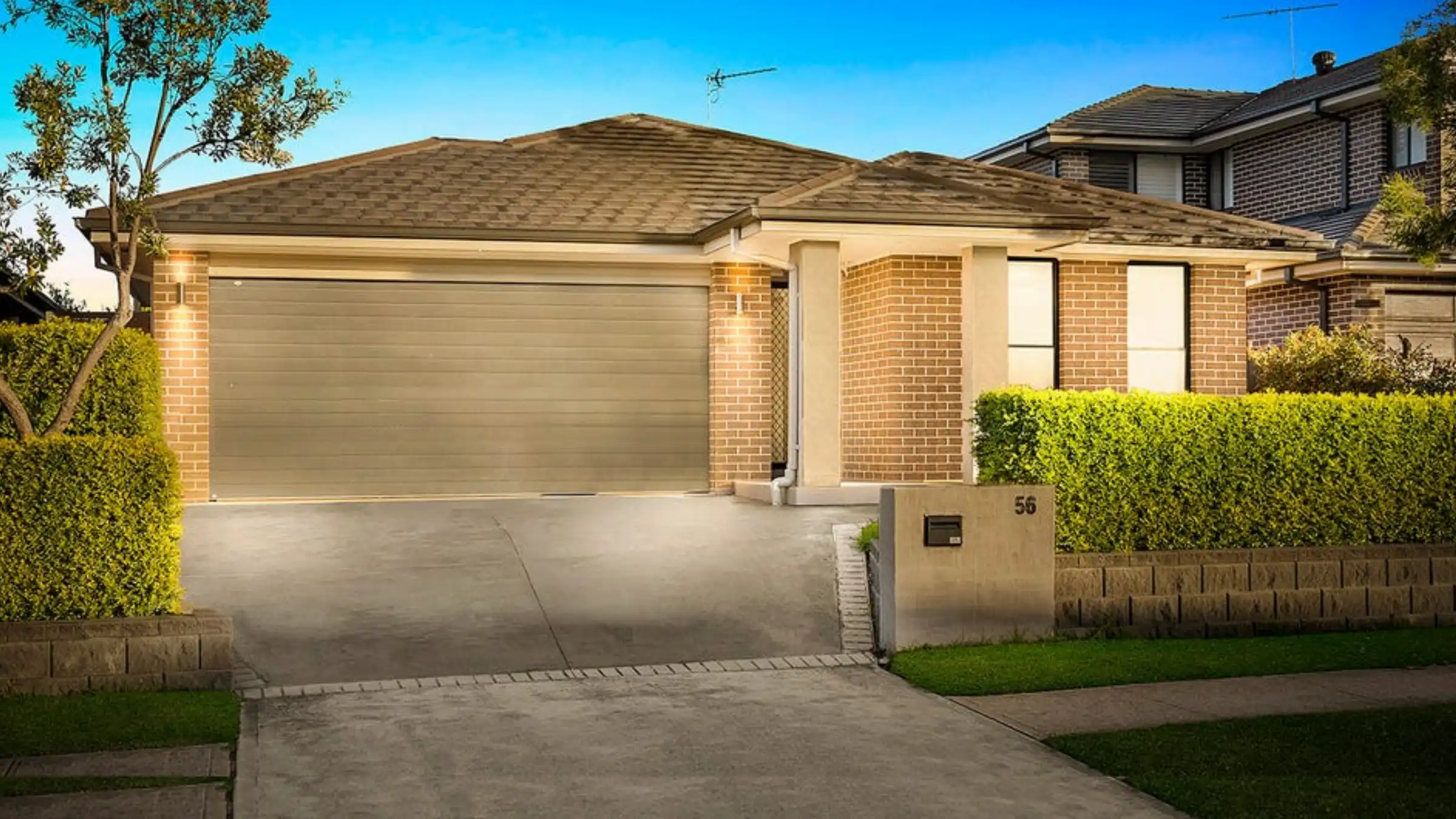
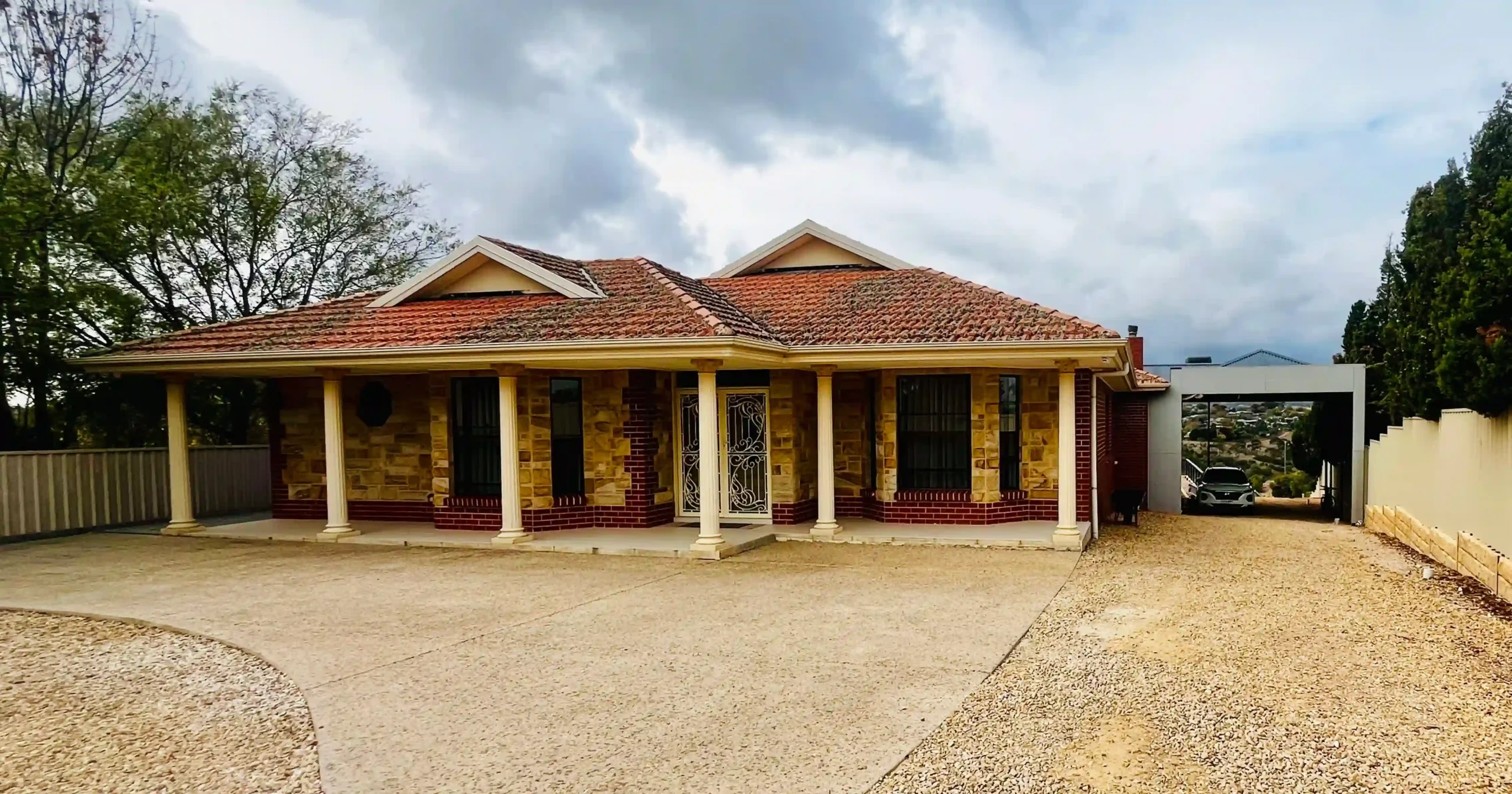
The house itself was a typical project home from 15 years ago. Brick facade, hedged front garden, a dark panel-lift garage door and a driveway that ran uphill from the street at a fairly steep grade. No steps – and no way to safely walk from the front door to the footpath for that all important daily movement.
Nothing about the house looked unsafe from the street. That’s part of what makes this issue easy to miss. It wasn’t falling apart or obviously dated. It just hadn’t been designed with the idea that the people living there would, one day, need a bit more support to move around it comfortably.
The Design Challenges
The real challenge here was that there was no staircase at all, just an open, sloped driveway between the road and the front door. That’s what I needed to solve first: how do you take someone safely from down there up to the house itself, when the existing approach is just a hill with nothing to hold onto and nowhere obvious to put a foot down.
Lighting came a close second. I wanted this couple to be able to leave for a walk at dusk, or come home after dark, and feel just as steady on their feet as they would in the middle of the day. That meant looking at the whole path of travel, not just the front door, and making sure it was lit well enough to use confidently at any hour.
Landscaping needed to work quietly in the background too. Neither of them wanted a garden that demanded constant upkeep, so I chose plantings and materials that would stay looking good with minimal maintenance, freeing up their time and energy for the things they actually wanted to do rather than tending garden beds every weekend.
And through all of it, the practical detail mattered as much as the overall design. Once I introduced proper steps and a handrail, that handrail needed to sit at the correct legal height, so it wasn’t just there for reassurance but actually met the standard a handrail is meant to meet.
The Design Decisions
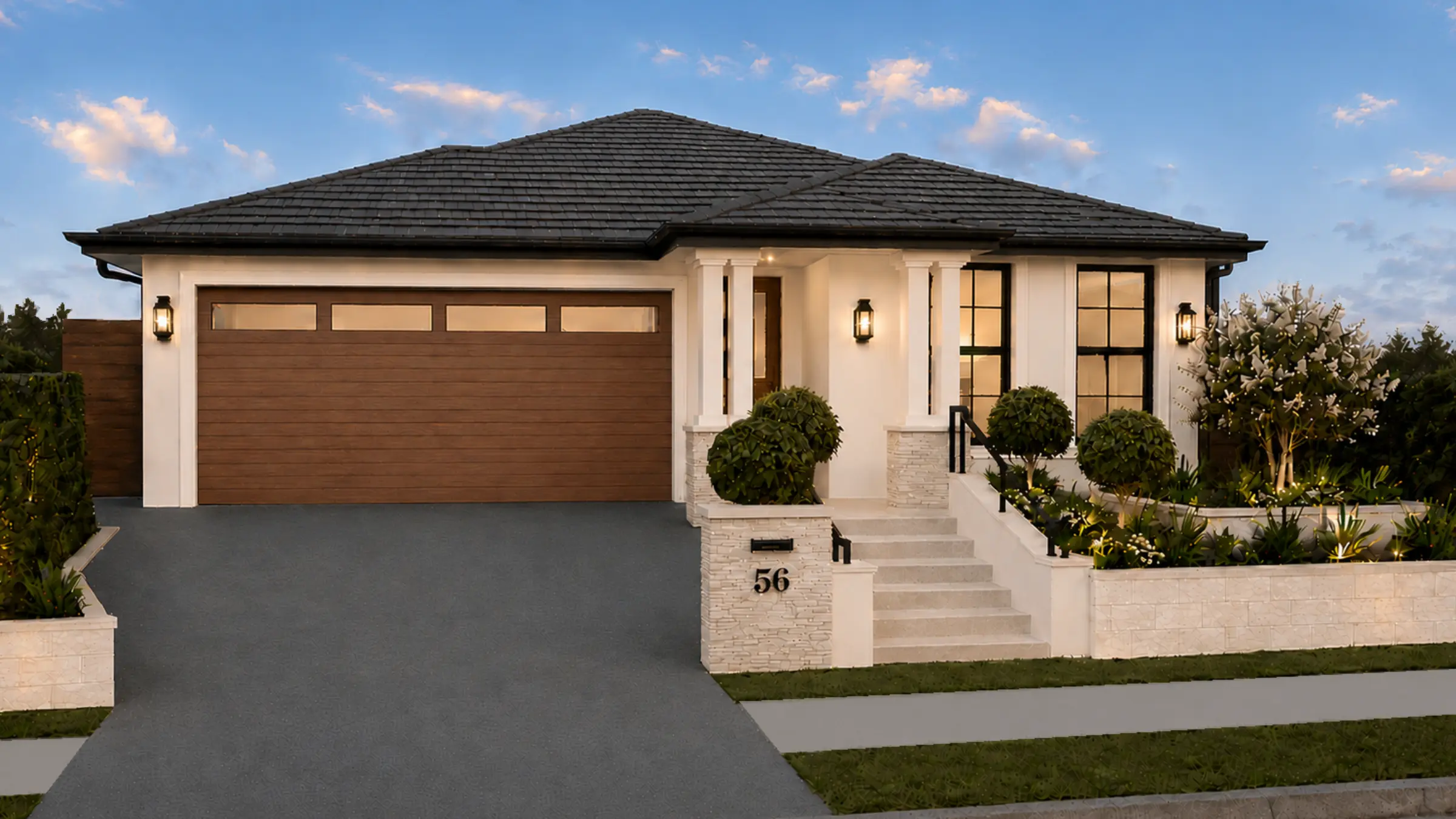
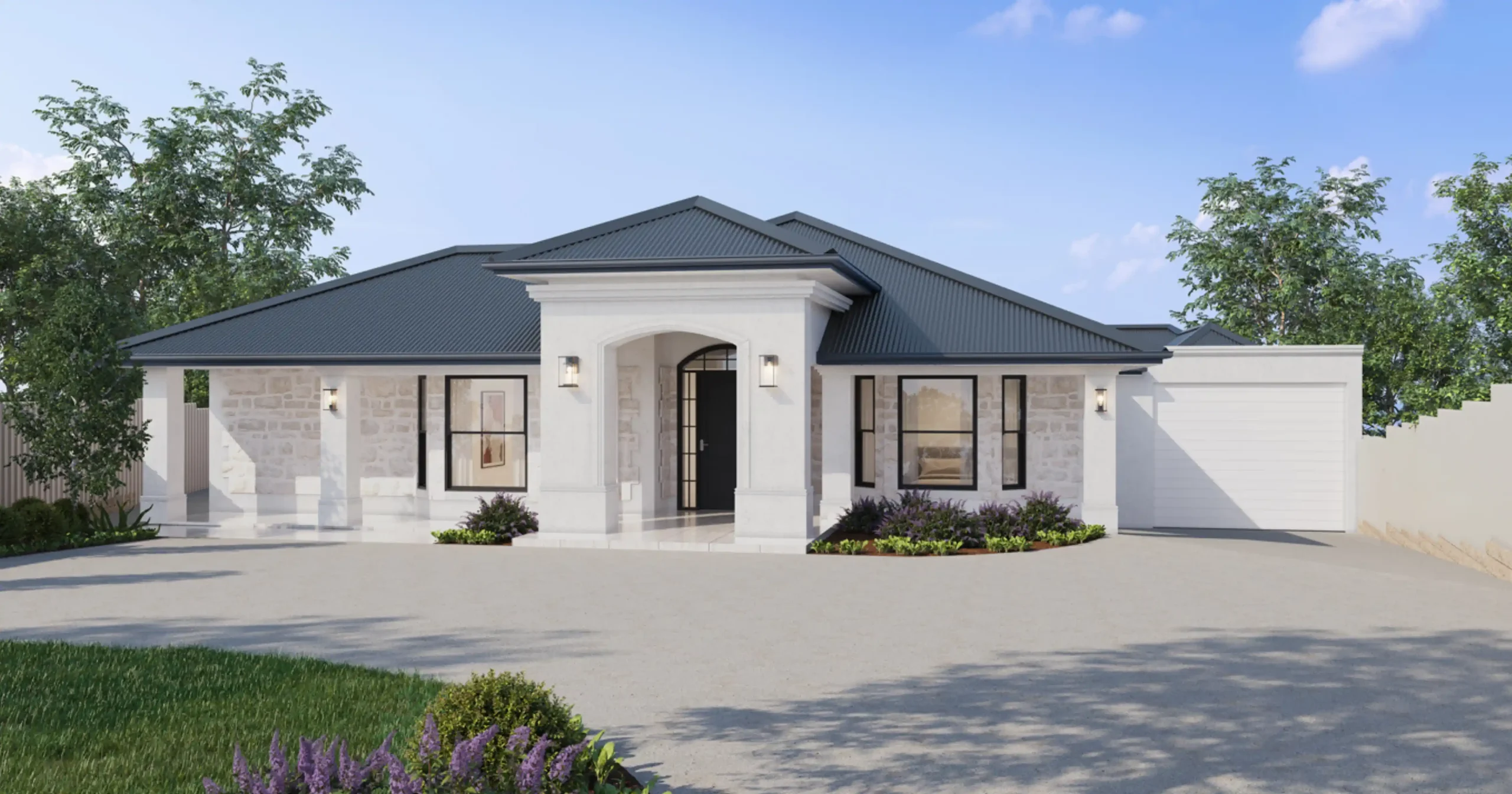
The existing retaining wall on site was staying, so that became a fixed point I had to design around rather than replace. I introduced new stone at the entry and stairs, but it needed to sit comfortably alongside that newly painted retaining wall rather than compete with it. Between the new stone and the existing wall, there was already a fair amount of texture and visual interest happening in that one part of the facade.
That’s why I kept the rest of the material palette quite plain. A simple render finish gave the stone and the retaining wall some breathing space, rather than layering in more texture or colour that would leave the whole facade feeling busy. Sometimes the most useful decision in a design is knowing where to stop adding things.
Lighting followed the same thinking. Along the garden beds and the stairs, I kept it deliberately subtle, since there was already enough going on there visually and I didn’t want light fittings adding another layer of detail. On the house itself, though, I used lighting more like jewellery. Wall-mounted fittings give the house extra interest during the day as well as after dark, so they’re doing double duty rather than only switching on when the sun goes down.
Landscaping needed to be low maintenance, but I didn’t want it to feel bare or overly manicured either. I wanted something soft. A tree on the right hand side of the block does a lot of quiet work here, balancing out the visual weight of the garage door on the left, even though a tree and a garage door have nothing obviously in common. This kind of balance is less about matching elements and more about making sure no single feature pulls your eye too hard in one direction.
Removing the old hedge along the front boundary was an important call too. It read more like a barricade than a garden, which isn’t the feeling you want when you’re trying to make a home feel inviting.
Colour was actually led by my clients on this one. They wanted a timber front door, timber garage door and a matching timber side gate. I loved that instinct, but timber that punchy needs the rest of the palette to step back and let it do the talking. That’s really why the stone and render work quietly in the background. There’s enough texture to keep things interesting, but not so much that it fights with the timber for attention.
The Outcome
Walking up to the house now, what you notice first is a warm, cohesive facade with a bit of texture and depth to it, courtesy of the stacked stone at the entry and letterbox pier. What you don’t notice, unless you’re looking for it, is that every step has been sized for an easy stride, that there’s a handrail exactly where a hand would naturally want to land, and that the whole path from street to front door is lit well enough to use confidently after dark.
That’s really the outcome I’m always chasing with this kind of project. The couple can still take the dog for a walk every morning. They can get the mail without a second thought. Visitors don’t clock anything unusual about the design, because there isn’t anything unusual about it. It just works in the background of daily life.
Practical Takeaways
If you’re thinking about how to help ageing parents, or yourself, stay in a much-loved home for longer, the exterior deserves the same attention as the bathroom or the hallway. A few things worth considering early:
- Look at the whole path of travel from the street or driveway to the front door, not just the steps themselves
- Check the rise and ‘going’ (tread depth) of existing steps against current accessible design standards, since older steps are often steeper than they need to be
- Integrate handrails and steps design into the overall material palette so they read as part of the home, not an add-on
- Add lighting along the entire approach, not just at the front door
- Use non-slip, textured surfaces for stairs and paths rather than smooth tiles or pavers
- Choose low maintenance plants that still bring softness and seasonal interest, so the garden looks after itself without ever feeling stark or bare.
A Gentle Invitation
If you or someone in your family is hoping to stay in their home for years to come, and you’re not quite sure where to start with the outside of the house, I’d be glad to talk it through with you. I offer a complimentary consultation for exactly this kind of conversation, no pressure, just a chance to look at your home together and work out what would genuinely help. Enquire about your home here.
Jane
📧 jane@hotspaceconsultants.com
🌐 https://hotspaceconsultants.com/preliminary-enquiry/
If you’re building or renovating a large home on a large block, there’s something you need to consider that you might not have thought about.
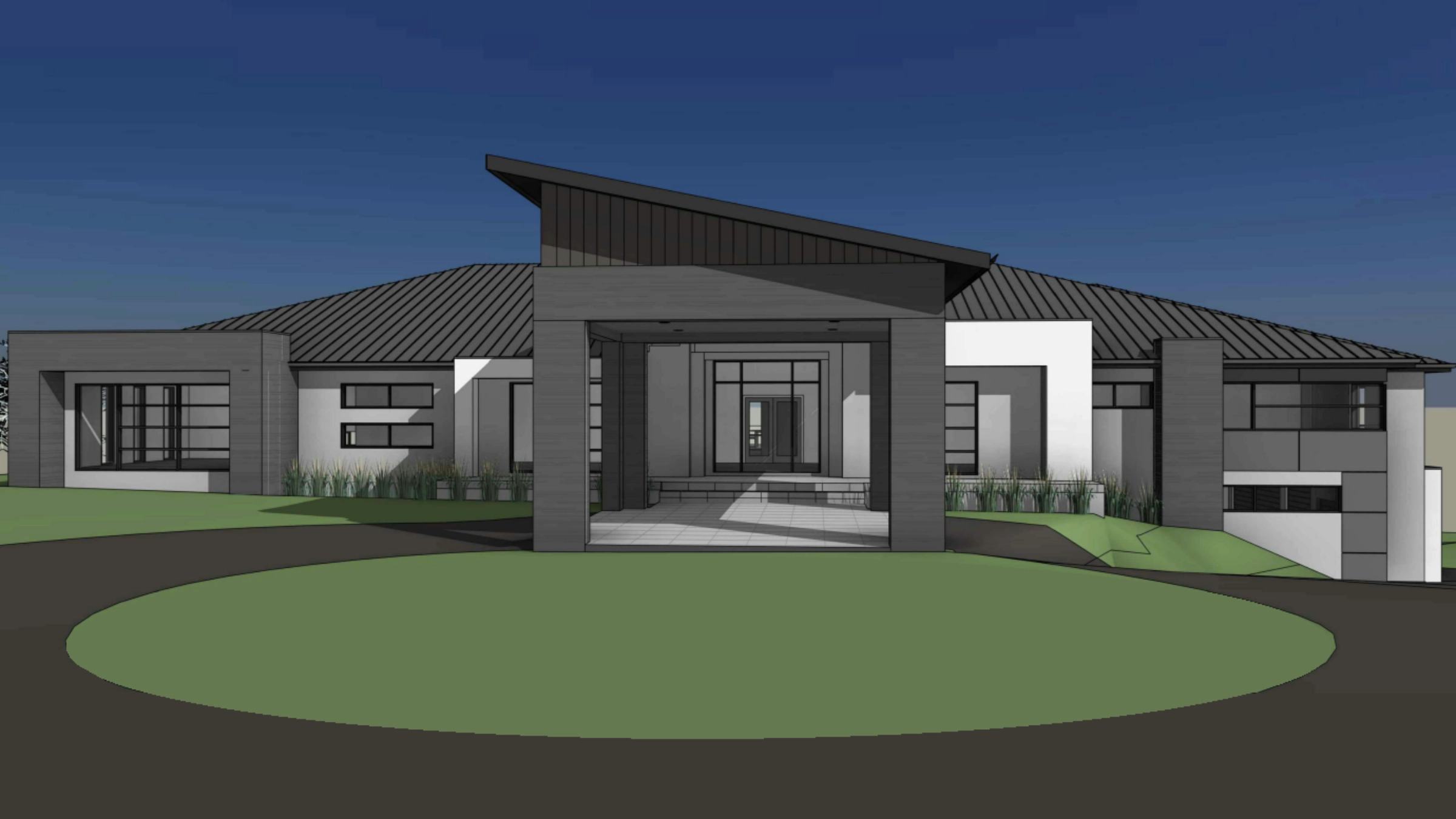
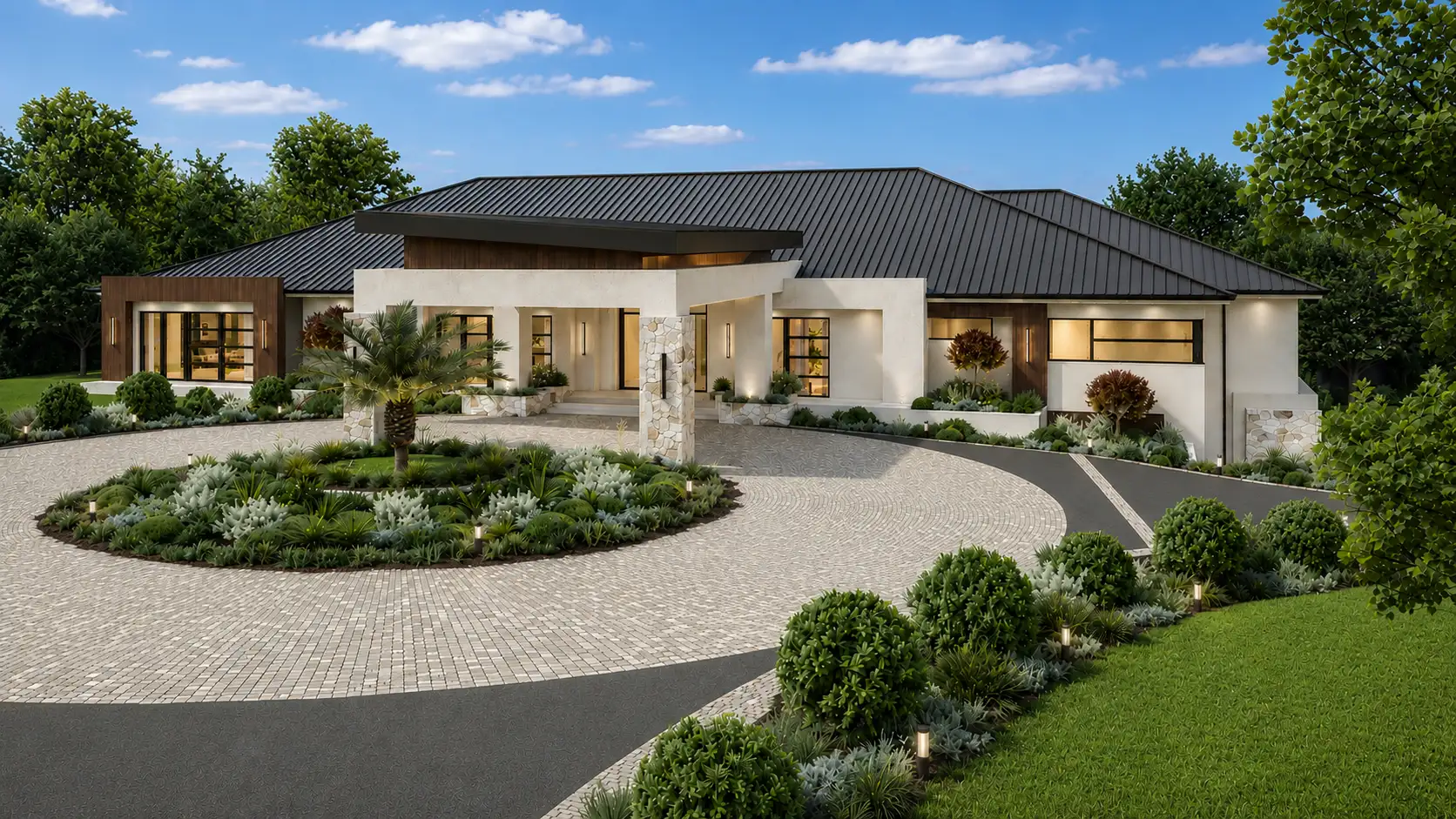
One of the mistakes I see with larger homes is choosing elements that might look perfectly appropriate on a typical suburban house, but suddenly look too small and insignificant when they’re placed on a much larger façade.
A beautiful exterior light can look too small and virtually disappear. Decorative mouldings can look too delicate. Even gutters, downpipes, roof profiles and architectural details can look strangely lightweight.
There may be absolutely nothing wrong with the individual selections. They’re just the wrong scale for the house.
✨ Designed by The Facade Design Co ✨
It’s not just about making everything bigger
You also should not make everything enormous! It’s about getting the proportions right.
A larger façade has more visual mass, so the elements within it need enough presence to hold their own.
That might mean:
- larger gutters and fascias
- a roof profile that suits the expanse of the roof
- larger-format stone, brick or cladding
- chunkier-looking columns or posts
- larger exterior wall lights
- deeper, more substantial architectural mouldings
- larger landscaping elements
- more substantial gates, fencing and letterboxes
And it’s not only the size of those elements that matters. The space between them matters too – because on a large façade, details positioned too closely together can make the exterior feel busy. Giving things more breathing room can create the sense of generosity and proportion that a larger home needs.
Think beyond the house itself
This same principle needs to extend across the entire property.
Your driveway, entrance, gates, fencing, pathways, retaining walls and landscaping all need to feel appropriate for the size of the house and block.
A standard entrance (even if that’s all you need), small pedestrian gate or collection of small plants, for example, can feel completely disconnected from a substantial home and expansive front yard.
The individual elements might all be beautiful. It’s their relationship to one another that makes the overall design work – or not work.
Why this is so difficult to get right as you go
Scale can be surprisingly difficult to judge when you’re selecting products individually.
An exterior light can look enormous in a showroom. A piece of stone can look substantial when you’re holding the sample. A front door can sound very wide when you’re reading its dimensions on a quote.
But put those same elements onto a large elevation and suddenly they can look very different.
And by the time they’re installed, changing them can be expensive.
That’s why the exterior should be designed as a whole before your renovation or build begins.
A complete façade design, particularly when you can see it in a colour illustration, allows you to see how the roof, doors, windows, lighting, mouldings, materials, driveway, fencing and landscaping relate to one another before you commit.
You’re no longer choosing a collection of individual things you like and hoping they’ll work together.
Instead, you can make every decision knowing it’s right for your home, your property and the finished look you want to achieve.
Planning a new build or renovation and want to make sure it comes together beautifully?
The Facade Design Co can help you design the whole exterior before you start – so you can see how everything works together and make your decisions with confidence. Enquire about your home here.
Jane
📧 jane@hotspaceconsultants.com
🌐 https://hotspaceconsultants.com/preliminary-enquiry/
Rendering brick is one of the fastest ways to take a tired, dated home and give it real street presence. It’s also one of the easiest ways to end up with a result that looks like every second house on the street. The difference comes down to the decisions made before the render even goes on. If you want to see what’s possible, have a look through our gallery of rendered facade transformations.
Why rendering brick works
Drive through any established suburb and you’ll see brick homes everywhere. Some still hold their own, but most feel stuck in the decade they were built.
Rendering brick works because it does two things at once. It hides the often-dated brick colours that no amount of cleaning will fix. And it gives you a clean surface to actually design with, rather than working around what’s already there.
Done well, rendering brick gets you a smooth, shaper finish that unifies the whole facade and the freedom to choose a colour that actually suits your home.
But the render itself is only half the job. What you do with it after is where most homes are won or lost.
✨ Designed by The Facade Design Co ✨
Getting the colour scheme right
Colour is where I see the most expensive mistakes happen. Homeowners fall for a bold or trendy shade, love it for two years, then spend money repainting when it starts to feel dated.
Neutral tones (whites, off-whites, warm greys) tend to be the safer, smarter choice, but they can come across as flat.
Texture is what stops it looking flat
The biggest hesitation I hear about rendering brick is that it’ll flatten the whole facade. Fair concern. Render on its own can look one-note if you don’t plan for depth.
The fix is layering texture and material against the render, not just painting over the brick and calling it done:
- Vertical timber battens or posts for warmth and rhythm
- Concrete-look cladding as a contrast panel
- A subtle texture change around windows or entry points
- Simple changes in render finish to create shadow lines
None of this needs to be dramatic. It just needs to be intentional. That’s the part that separates a home with genuine street appeal from one that just looks freshly painted.
What else pulls the look together
Rendering brick changes the base. What sits on top of it is what makes the home feel finished rather than half-renovated.
A few upgrades that consistently make a difference:
- A new front door with proper hardware, not an afterthought
- Windows that suit the new proportions, whether that’s slimline or oversized
- A garage door finished to match or intentionally contrast
- Roofing that doesn’t fight with the new facade colour
- Lighting that highlights architecture instead of just lighting a path
The part most people skip
Rendering brick is a big decision, and it’s permanent enough that getting it wrong is a genuinely costly mistake to fix. The homeowners who end up happiest with the result are the ones who plan the whole facade before a single tin of render is opened, not just the render colour in isolation.
That’s the part I help with. Not ideas or inspiration, you likely already have plenty of that. What you need is a plan that ties the render, the materials, the colours and the architectural details together into something that can actually be built, and that still looks right in ten years.
If you’re weighing up rendering brick and want to get it right the first time, book a preliminary enquiry (link below) and let’s talk through what your home actually needs.
Jane
📧 jane@hotspaceconsultants.com
🌐 https://hotspaceconsultants.com/preliminary-enquiry/
Nine times out of ten these days, clients arrive at their first meeting with me armed with a selection of A.I-generated images. I welcome it. Bringing these to our first conversation is one of the most useful things a client can do before we sit down together.
Using A.I for exterior design inspiration has become part of how many people begin thinking about a renovation. It offers me a window into what they’re genuinely picturing.
Why I Welcome Using A.I for Exterior Design Inspiration
Clients can generate a handful of A.I images. They can assemble a Pinterest board, or gather photographs of homes that have caught their eye. Then they bring all of it to our first meeting.
From that point, I’m no longer guessing. I can see the proportions they’re drawn to. I can see the materials that appeal to them, the palette that feels right, and the overall character they’re hoping to achieve.
My advice to anyone beginning this process is simple. Gather freely. Generate the images. Build the board. Collect what genuinely appeals to you.
Don’t worry about whether it’s the “correct” kind of inspiration. Don’t worry about whether it will translate directly to your home. That question isn’t yours to answer. It’s mine.
The Distance Between Inspiration and Your Own Home
This is where the process becomes more nuanced. It’s also where people can run into difficulty if they attempt it without a designer’s guidance.
Sometimes the ideas a client brings me translate beautifully to their house. Other times, there’s a genuine mismatch between the inspiration and the home they own. This isn’t a matter of taste. Every house is different. Each one has its own position on the block, its own structure and roofline, and its own context among neighbouring homes. These factors all shape what will actually succeed.
An A.I or Pinterest image shows a finished result on someone else’s house, under someone else’s conditions. It doesn’t show the version of that idea suited to your particular home. Getting to that version is a different exercise altogether. It depends on experience.
Sometimes an idea transfers almost as it stands. More often, what transfers is just the seed of it. A mood. A material. The way a roofline sits. From that seed, something new gets built that genuinely belongs on your house.
Copying an inspiration image directly onto a home it was never designed for is usually where the trouble starts.
How I Translate Inspiration Into a Design That Works
This is the part of my work I find most rewarding. It draws on my 30 years as a designer.
When a client brings me a collection of A.I images and saved references, I don’t treat them as a finished brief to be replicated. I read them as clues. What proportions do they return to. What textures recur. Is there a pattern in the colours, even one the client hasn’t consciously noticed.
From there, my task is to work out how much of that inspiration can genuinely carry across to their specific house. I also need to work out how to adapt what can’t. That way, the feeling they were drawn to gets preserved, but built correctly for their home, their budget and their council requirements.
Here are some of the practical things I’m weighing up at this stage:
- Whether the materials shown in the inspiration suit the local climate and are reasonably available
- How the proportions of the inspiration will sit against the existing roofline, windows and block shape
- What council or planning restrictions might affect particular elements
- Where the budget is best directed for the greatest visual and structural impact
- Which elements of the original idea are essential, and which offer more flexibility
This is where considered design proves its value. It’s not about discarding what a client is drawn to. It’s about finding how to carry its essence onto a house it was never conceived for.
Practical Takeaways
If you’re in the early stages of planning a renovation, here’s what I’d suggest. Take the time to gather ideas. Use A.I tools. Assemble a Pinterest board. Look on Google. Photograph homes that catch your eye as you go about daily life.
Don’t deliberate over whether it’s the “right” kind of inspiration. Just collect what genuinely appeals to you.
Then bring all of it to your first conversation with a designer. Not as a finished brief, but as the beginning of a conversation about what will genuinely suit your home.
If you’d like to book a complimentary consultation to talk through your ideas, I’ll see if I can help.
Jane
📧 jane@hotspaceconsultants.com
🌐 https://hotspaceconsultants.com/preliminary-enquiry/
Not every element of my client’s renovations is up for discussion. Sometimes a homeowner has windows (or a roof, wall cladding etc) in perfectly good condition that simply aren’t in the budget or the plan to replace, and the whole facade design needs to work around that fact rather than against it. That was the situation on this project. The existing brown windows were staying exactly where they were, so my job was to design a facade that made them look like a deliberate choice rather than something left over from before.
It’s one of the more interesting briefs I get, because the constraint actually sharpens the design thinking rather than limiting it.
👇👇 Designed by Hotspace 👇👇
The Starting Point
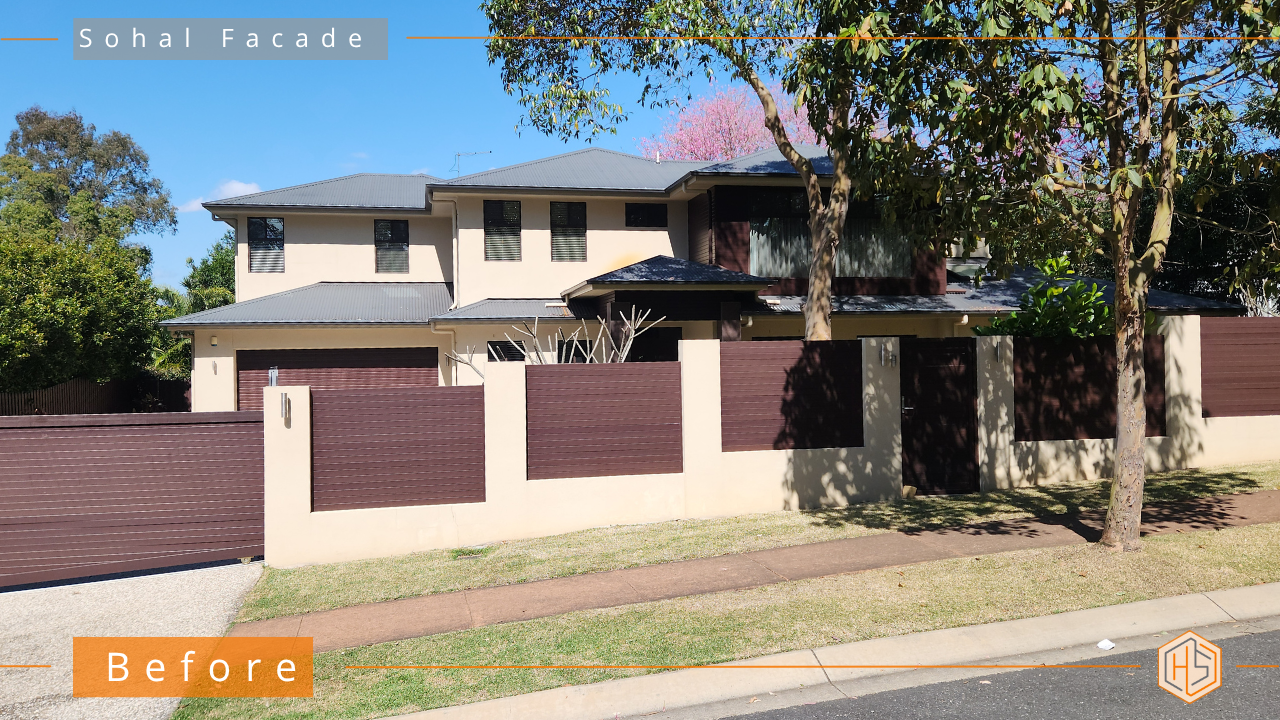
This home originally had a pale, slightly dated cream render, a mid grey roof, and a front fence and matching garage door finished in a dark-ish timber paneling. The brown window frames sat throughout the home, original and staying put. On their own, none of these elements were a problem. Together, the palette felt flat and a decade or more out of date.
My clients also had a garage addition already designed by their building designer, planned for the left-hand side of the home. So alongside the facade refresh, I needed to make sure that new structure felt like part of the same house, not something bolted on afterwards.
The Design Challenges
The brown windows were the real fixed point of this project. Windows sit all over a facade, which means whatever palette I chose needed to sit comfortably next to that colour in multiple places, not just once near the front door.
The garage addition added another layer. It had already been drawn up structurally, so my role was to bring it into the same design language as the existing home, particularly around the large feature window on the top right, which lights the master bedroom and needed to read as part of one cohesive composition rather than a separate wing.
I also wanted to darken the roof. A darker roofline gives the eye something to anchor to, and it works particularly well alongside timber and stone tones.
The Design Decisions
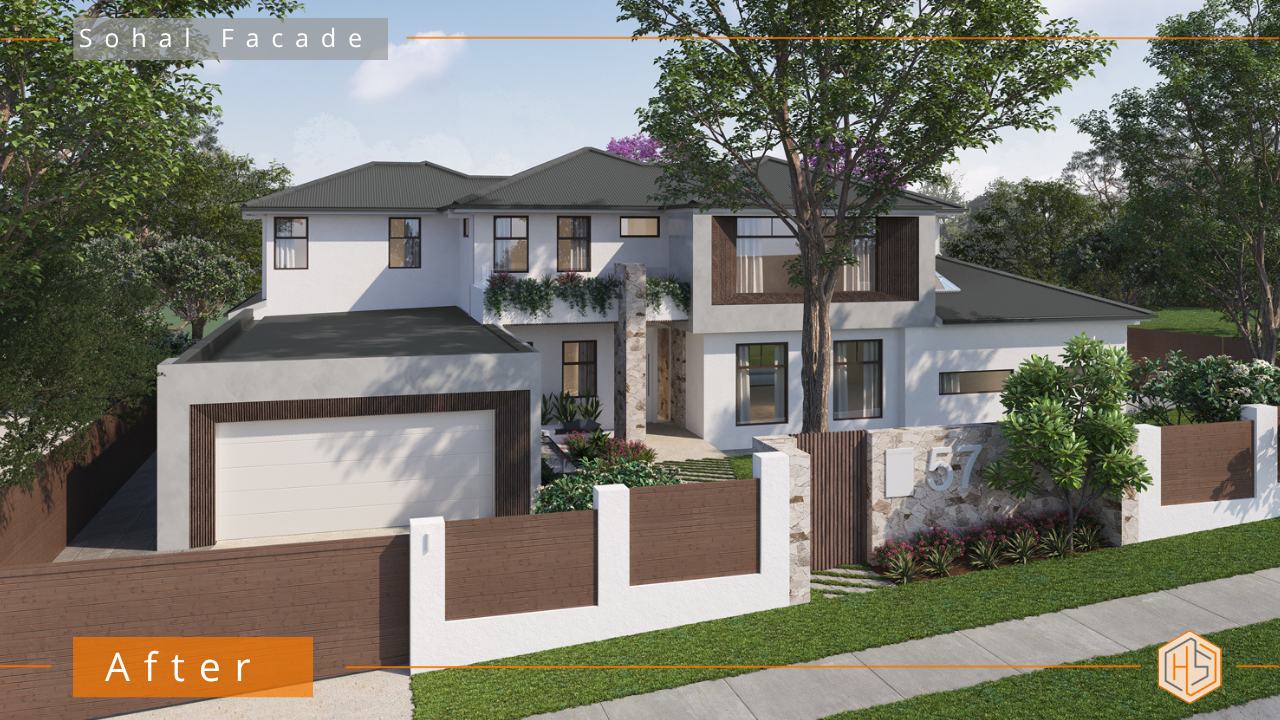
I moved the walls from that creamy tone to a fresher, lighter colour, which immediately brought the home into the present day. That single shift does more heavy lifting than almost any other decision on a facade.
To bring the brown windows into the story rather than fighting them, I added considerably more timber across the facade, particularly around the upper bedroom window and garage door. The previous fence read as leftover and disconnected. Bringing in timber at a similar tone to the windows meant the whole facade started to feel intentional, like the colour was a choice rather than a compromise.
I introduced a stone feature to act as the glue between the timber tones and the new lighter render. Stone does that job well. It’s warm enough to sit alongside timber, but structured enough to read as considered rather than decorative.
For the new garage and the area around the feature window, I used a concrete-look render, which gave that section its own texture without pulling away from the rest of the home. It let the garage and the master bedroom’s feature window feel connected to the existing house and the front fence, rather than competing with them.
Landscaping came in at the end to soften all of this. Once you introduce more hard materials like timber and stone, the garden needs to do some balancing work, so I added planting around the entry and fence line to take the edge off the new elements and let everything settle together.
The Outcome
The finished facade doesn’t look like a home working around a limitation. It looks like the brown windows were part of the plan from day one, because by the time I’d finished, they were. The darker roof, fresher render, added timber and stone feature all work together, and the new garage addition reads as though it was always part of the original house rather than an afterthought.
That’s really the test of a good facade design when you’re working with existing elements. Nothing should look retrofitted. It should look like every decision, old and new, belongs to the same idea.
Practical Takeaways
If you’ve got an existing feature you can’t or don’t want to change, here’s what I’d suggest:
- Identify your true fixed point early, whether that’s windows, a roof, or a fence, and design everything else in relation to it
- Look for a material in a similar tone to bring that fixed element into your new palette rather than isolating it
- Use one connecting material, like stone or a feature render, to link old and new sections of the same home
- Don’t skip landscaping. Softer planting balances harder new materials like timber and stone
- If you’re adding a new structure, like a garage, make sure it’s designed to match the existing home’s character, not just sit next to it
Working through a full facade design plan before construction begins is what makes all of this possible without guesswork on site. If you’d like to see how that process works in more detail, there are some frequently asked questions about facade design plans on the site.
If you’ve got existing windows, a roof, or any other feature you’re keeping as part of your renovation, I’d love to help you design around it properly rather than in spite of it. I offer a complimentary consultation for homeowners who want clarity before committing to materials or builders. Get in touch and let’s talk through your place.
Jane
📧 jane@hotspaceconsultants.com
🌐 https://hotspaceconsultants.com/preliminary-enquiry/
I get asked some version of the same question almost every week. Someone sends me a photo of their house, usually looking a bit sheepish about it, and asks whether it’s actually possible to make it look like a different place. Not just tidied up. Different.
This project is the answer I wish I could hand to every one of those homeowners.
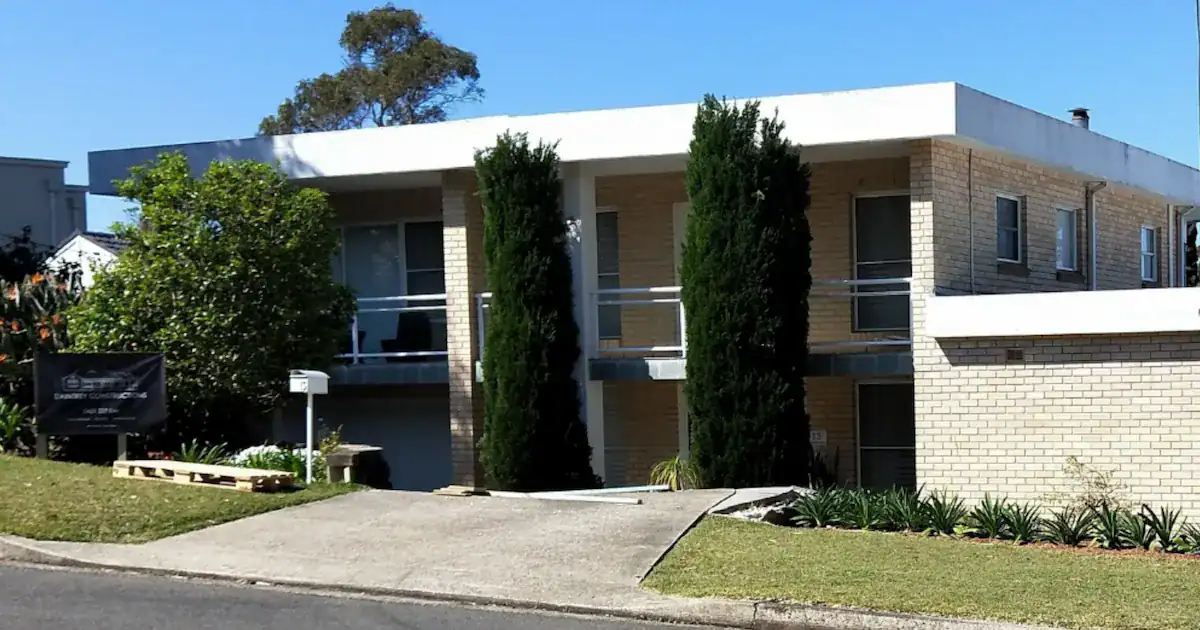
The house was built in 1962. Two storeys, a flat roofline, a balcony running the full width of the upper level. When the owners first showed it to me, I understood straight away why they felt a bit stuck with it. The brick was original, the balcony rail was plain and a little tired, and a couple of conifers out front had grown so tall they were starting to swallow the entry whole. It looked like a house from a particular decade. Because it was one.
What it turned into tells a completely different story, and here’s the thing that always catches people off guard: the shape barely changed at all.
👇👇 Designed by Hotspace 👇👇
The Starting Point
The bones of this place were genuinely good. A generous footprint, a clean rectangular form, sensible proportions between the two levels. The problem was never the structure underneath. It was everything sitting on top of it.
The brick was a flat, even cream with no texture and nothing for the light to catch. That single thin balcony rail did nothing to frame the upper level. There wasn’t any real separation between where the garage (on the right) ended and the main home began, so the whole facade just read as one long, flat plane. The garden had been left to do its own thing for a while, too, which meant plenty of established greenery, but none of it working with the house.
Why This Kind of Transformation Isn’t About Starting Over
The shape of this house was never the issue. What needed to change was the materials, the detailing, and how all those elements related to each other. So my approach became about layering rather than rebuilding. Where could I introduce depth through a change in material? Where could shadow lines do some work without touching a single wall? Which parts of the existing form deserved to be reframed instead of ripped out?
I kept coming back to a few questions as I worked through it. Where does the eye land first, and is that actually the right spot? What can I simplify so the good bits have room to breathe? Which materials will still look right in twenty years, in this light, in this climate? And just as importantly, what needs to fade into the background so something else can stand out?
People often assume a striking result needs a bigger scope. In my experience, it usually needs a more considered one.
The Design Decisions
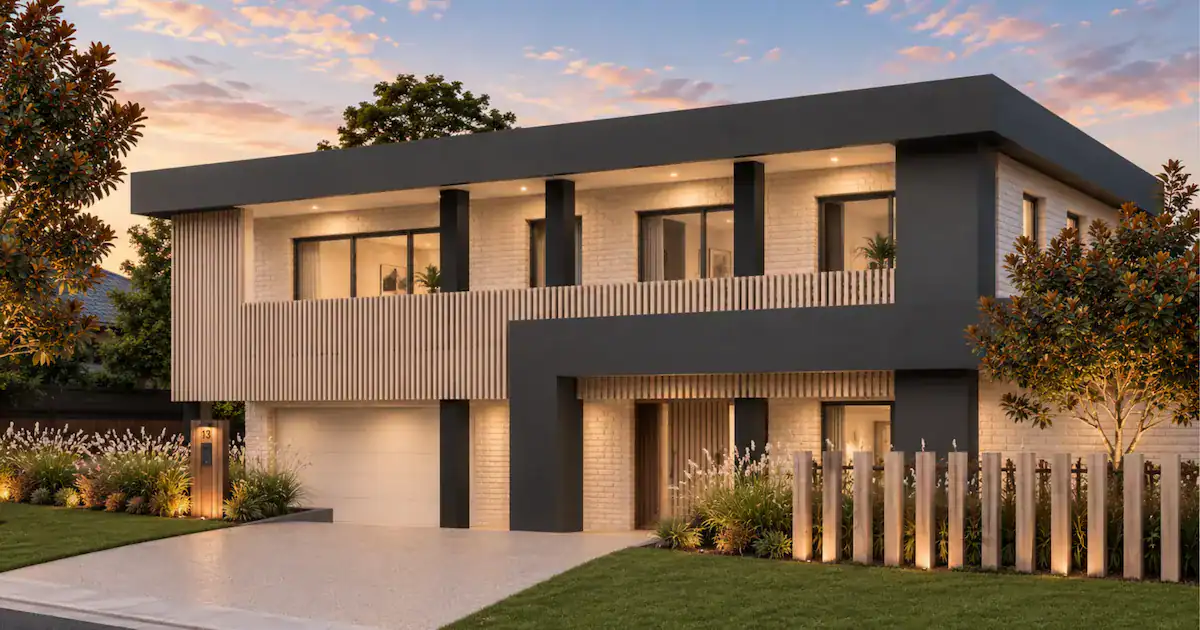
The biggest single shift was breaking the facade into distinct zones instead of treating it as one unbroken brick surface. The upper level took on a dark rendered finish, and that alone gave the roofline and top storey a sense of weight they’d never had. Suddenly it looked intentional, rather than like leftover brick that happened to keep going upward.
Vertical timber-look (aluminium) battens became the thread running through the whole design. They show up on the front door, they wrap the balcony, and they reappear again on the mailbox. Repeating a material like that across different parts of the house does something quite subtle. It tells the eye this is all one idea, not a handful of separate decisions bolted together.
The ground floor kept the lighter (existing) brick tone, which grounds the whole composition and sets up a contrast against that darker render above. That contrast is doing more work than people realise. It’s what gives the facade its sense of proportion, and it’s the reason the whole thing doesn’t read as flat anymore.
Lighting mattered more here than most people expect from a facade brief. Low garden lighting along the front bed, some warm up-lighting, ceiling lights along the balcony – and the whole composition reads differently once the sun goes down. A facade that only works in daylight is only half finished, as far as I’m concerned.
Even the fence became part of the story. A timber-look style that echoes the batten pattern on the house replaced what could easily have been an afterthought at the boundary. It’s a small decision on paper, but it’s part of why the finished result feels resolved instead of assembled.
The Outcome
What strikes me most is how the materials do the talking – through contrast and through texture.
The shape underneath hasn’t really changed. Same footprint, same proportions, same relationship between the two levels. What’s different is everything sitting on that shape, and that’s really the whole point of this project. A house doesn’t need a new outline to become a different place. It needs a design language that suits how the people living there actually want to feel walking up to their own front door, rather than whatever the house happened to look like the decade it was built.
I’m always a little cautious about the word transformation, if I’m honest about how it gets used in marketing. What I’m aiming for isn’t a dramatic before-and-after moment. It’s a result that still looks considered in another twenty years, not just striking on the day the photos get taken.
Practical Takeaways
If you’re looking at an older home and assuming its current style is locked in, it isn’t. A few things this project reinforced for me:
- Shape and style are two completely separate conversations. Don’t let one convince you the other is fixed.
- Contrast between materials, not just colour choices, is usually what creates a genuine sense of a new identity.
- Lighting deserves to be part of the brief from day one, not something tacked on once the build is underway.
A home from the sixties, or from any era really, with solid bones underneath is often a far better starting point than people give it credit for. The hard part was never the age of the house. It was working out what it actually needed to feel like itself again.
If you’re standing in front of a home that feels a bit stuck in its era and wondering whether it’s worth doing anything about, I’d love to talk it through with you. A complimentary consultation is a relaxed way to find out what’s possible before you commit to anything at all. Click on the ‘preliminary enquiry’ link below to book in a time.
Jane
📧 jane@hotspaceconsultants.com
🌐 https://hotspaceconsultants.com/preliminary-enquiry/